


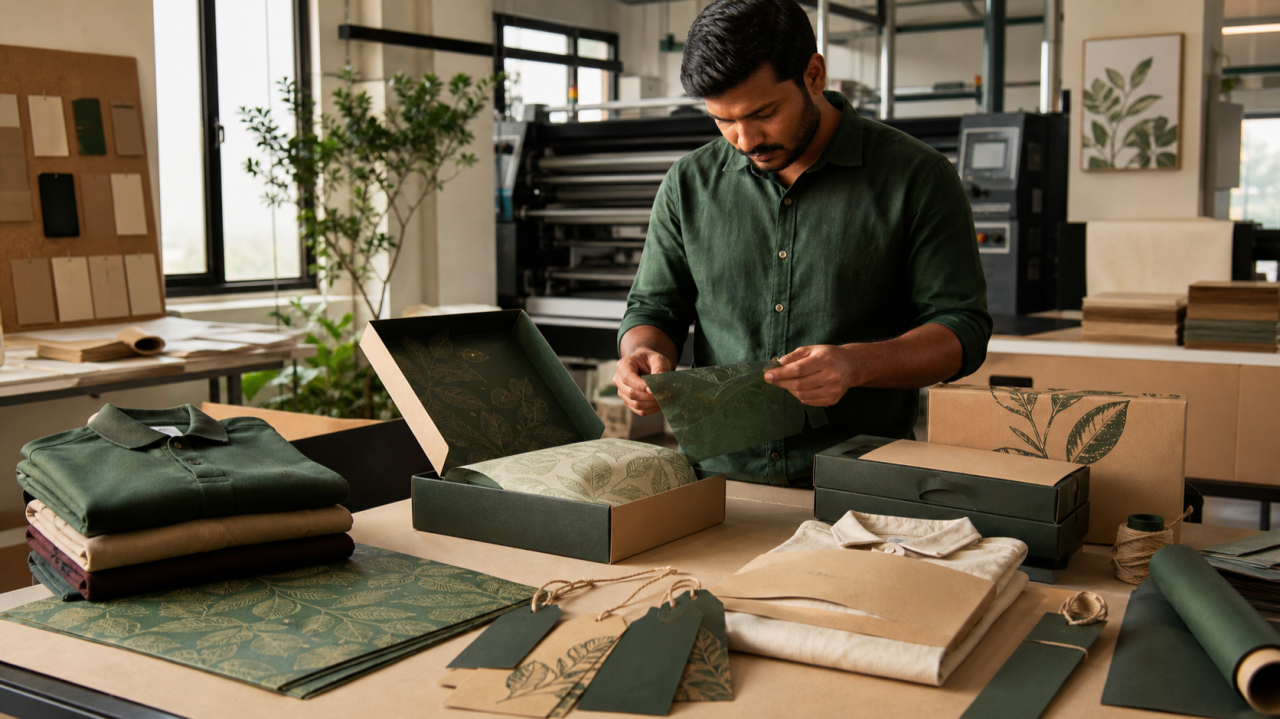
For an apparel brand, packaging has several jobs before the customer even touches the garment. It protects a carefully finished product, communicates size and care information, supports warehouse accuracy, survives transport, creates an opening experience and expresses the brand’s position. When these needs are handled as separate print orders, the result can become wasteful, inconsistent and expensive.
A better textile-packaging system begins with the garment and its journey. A premium shirt displayed in a store, an e-commerce saree travelling across India, a children’s-wear export order and a bulk institutional uniform do not need the same box, board, tag, insert or shipping protection. Define the route, handling risks, customer expectation and sustainability requirement before design begins.
Quick answer: Match the garment size, folding method, distribution channel and intended brand experience to the right paperboard box, corrugated shipper, tissue, sleeve, hang tag, label and print finish. Confirm material specifications, prototypes, colour standards and quality checkpoints before production.
Why textile packaging is a system—not just a box
The customer may see one attractive carton, but operations handle a connected set of components. The garment may be folded around a board, wrapped in tissue, secured by a paper band, placed inside a mono carton or premium box, labelled with SKU information, grouped into an outer corrugated carton and protected through warehouse and courier handling.
Each layer should have a purpose. Extra packaging that adds no protection, information or experience increases material, assembly time, weight and disposal. Too little packaging creates creasing, moisture exposure, abrasion, tampering or returns. The goal is a right-sized, repeatable system.
Map the journey from finishing table to customer. Identify how many times the product will be stacked, scanned, opened, repacked and transported. Packaging decisions become clearer when everyone works from the same journey.
Common packaging components for apparel brands
- Folding cartons: lightweight paperboard boxes for shirts, innerwear, accessories and retail presentation.
- Premium paperboard boxes: stronger structures for gifting, occasion wear and high-value garments.
- Corrugated mailers and shippers: transit protection for e-commerce and wholesale distribution.
- Paper sleeves and belly bands: compact branding and closure for folded products.
- Tissue and interleaving paper: surface protection and a refined opening layer.
- Hang tags and swing tags: brand story, price, size, barcode and product information.
- Care labels and stickers: fibre content, wash guidance, batch, SKU and fulfilment information.
- Inserts: care guidance, thank-you notes, authenticity information or return instructions.
Do not select a component simply because competitors use it. Decide whether it protects, informs, sells or simplifies operations.
Start with garment dimensions and fold geometry
A box designed from the outside inward often contains unnecessary air. First standardise the garment fold and measure the product in its natural packed condition. Include variations caused by fabric thickness, size range, embroidery, padding or accessory bundles.
Allow enough clearance for efficient packing without movement that destroys presentation. A box that is too tight can crush embellishment and slow assembly; one that is too loose needs more filler and occupies extra storage and transport space. Where possible, rationalise several SKUs into a small set of carefully tested box sizes.
Confirm how boxes will be stacked. Compression can affect lower cartons even when each unit feels strong by hand. For e-commerce, test the complete pack inside its shipping environment rather than evaluating an empty presentation box.
Paperboard, kraft and corrugated material choices
Material selection affects strength, print colour, fold performance, weight, appearance and recyclability. Solid bleached or coated boards offer a smooth, bright print surface. Kraft-based boards provide a natural material-led appearance and may reproduce colour differently. Corrugated board adds cushioning and stacking strength through its fluted structure.
Ask the printer or packaging converter to specify more than a generic material name. Board grade, grammage or caliper, flute type where relevant, fibre composition, finish and converting direction matter. The correct specification depends on the structure and load, not simply the highest number.
Prototype with production-intent material. A white mock-up proves size and folding, but may not reveal cracking, scuffing or colour behaviour on the final board.
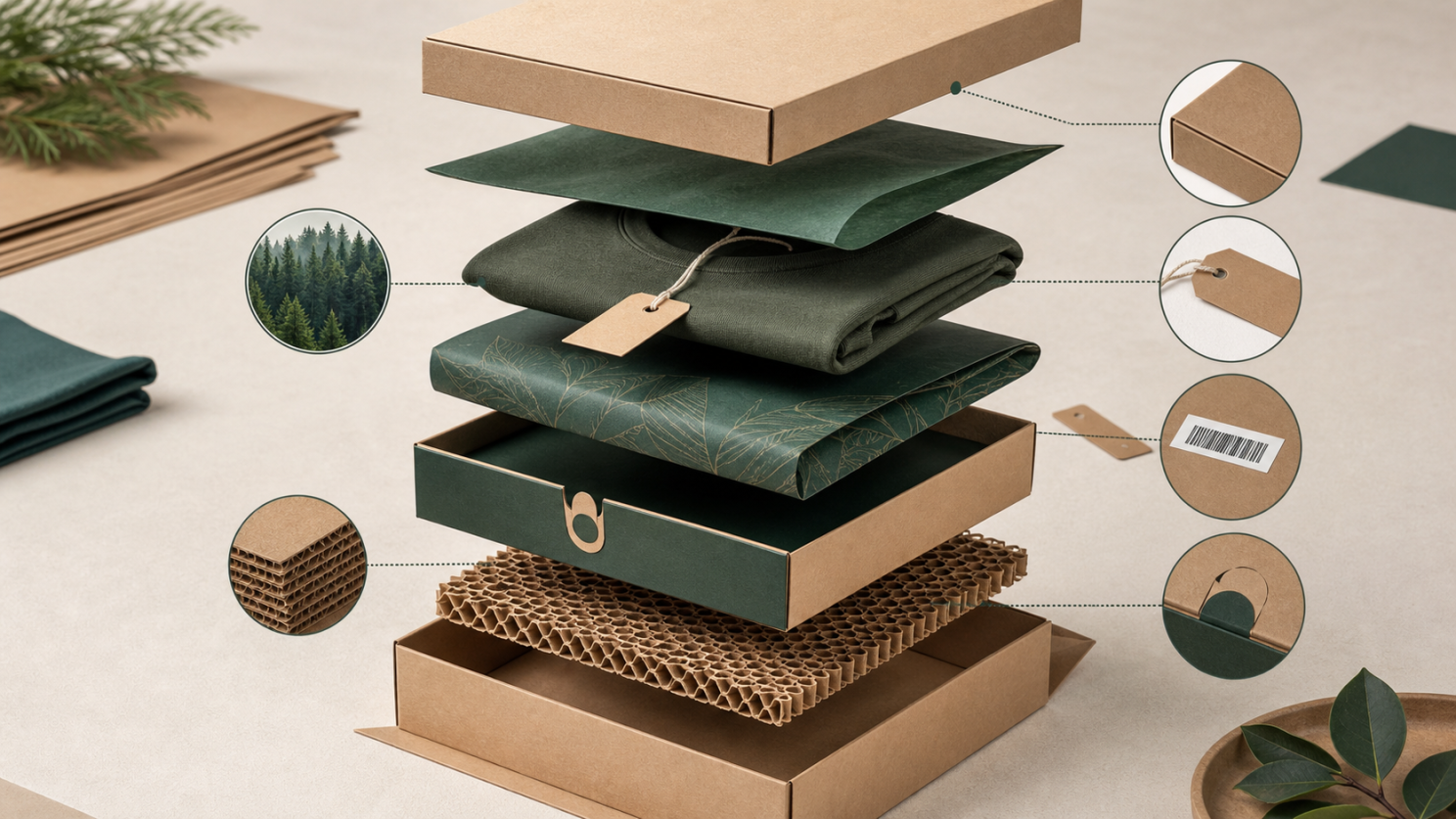
What FSC-certified packaging means for a brand
The Forest Stewardship Council system supports responsible forest management and chain-of-custody control for forest-based materials. For a brand, the important distinction is between working with a certified organisation and making a specific on-product claim about a specific packaging item.
If an FSC label will appear on packaging, confirm that the material and transaction are eligible and that the label artwork and approval follow the applicable requirements. A supplier’s general certification does not mean every board in every order automatically carries the same claim. Request relevant certificate details, product information and claim documentation for procurement records.
Responsible sourcing is one part of sustainable packaging. Right-sizing, material reduction, low-waste production, recyclability, avoidance of unnecessary lamination, efficient transport and honest consumer guidance also matter.
Printing methods for textile packaging
Offset printing
Offset can deliver detailed images, consistent brand colours and efficient production for suitable quantities. It supports a broad range of coatings, foils, embossing and other finishes. Setup makes accurate artwork and pre-production approval important.
Digital printing
Digital can be useful for lower quantities, rapid iterations, multiple versions and personalised or seasonal work. Unit economics, colour expectations and substrate limits should be checked against the project.
Flexographic printing
Flexography is commonly used for corrugated and high-volume packaging. It can provide strong, efficient graphics when the artwork is designed for the process. Fine detail and colour expectations should be aligned early.
The choice is not only about quantity. Board, structure, colour count, artwork detail, finishing, delivery schedule and version count all influence the recommended method.
Finishes that add value—and finishes that add waste
Matte or gloss coatings, spot effects, foil, embossing, debossing, texture and windowing can improve shelf presence. However, multiple decorative layers can complicate recycling, increase rejection risk and make replenishment expensive. Use finish to create hierarchy, not to decorate every surface.
For many textile brands, a well-printed uncoated or lightly coated board, a tactile tag and one precise accent can feel more premium than excessive lamination. Test rub resistance and cracking along folds, especially on dark solid colours and uncoated boards.
If a transparent window is essential, consider material separation and disposal. If it is only decorative, a die-cut reveal or printed product illustration may offer a simpler alternative.
Hang tags: small component, large brand impact
A hang tag can carry the brand, price, barcode, size, collection story, care guidance, certification claim or digital link. The information hierarchy should help both the customer and store associate. A beautiful tag that hides the SKU creates an operational problem.
Specify tag dimensions, board, printing sides, hole or eyelet, cord material, knot or seal, attachment point and finishing. Test the tag against delicate fabric: sharp corners, metal eyelets or rough cord can snag. Confirm barcode quiet zones, contrast and scanning after printing.
Version control is critical when sizes, colours, prices, languages or destinations change. Use a clear artwork naming and approval system so an old tag is not produced for a new batch.
Colour management for consistent brand packaging
The same artwork looks different on bright coated board, kraft stock and corrugated liner. Screens display RGB light, while print uses process or spot inks. A PDF approval confirms content and layout but cannot perfectly prove production colour.
Define critical brand colours with appropriate standards, approve physical proofs or drawdowns where needed, and retain a signed master sample. Agree an acceptable tolerance, viewing light and process for handling variation. Metallics, deep blacks and large solid areas need special attention.
Consistency also depends on paper batch, ink, coating, drying and finishing. A quality partner should record production details for repeat work.
Quality checks that reduce packaging failures
- Dimensions, fold accuracy and garment fit.
- Board, flute, grain direction and strength specification.
- Artwork revision, spelling, barcode and mandatory information.
- Colour against the approved standard.
- Registration, print density, scuffing and set-off.
- Die-cut accuracy, crease quality, cracking and glue strength.
- Foil, embossing, lamination or coating alignment.
- Packing count, SKU segregation and shipping protection.
A golden sample is valuable only when it is clearly approved and controlled. Retain it with the specification and artwork revision. For critical orders, establish inspection stages rather than waiting until the entire quantity is complete.
How to prepare a textile packaging brief
A useful request for quotation should include the garment type, folded dimensions and weight; expected sizes and variants; sales channel; monthly and annual quantity; desired opening style; material preference; print colours; finishes; tag and insert requirements; barcode process; certification claim; packing method; delivery location and launch date.
Share a physical garment sample when possible. Dielines and artwork should be treated as separate approvals. The structure can be technically correct while graphics still cross a fold or place critical information under a closure.
Ask the supplier to identify cost-saving alternatives rather than simply reducing quality. A common board size, reduced ink coverage, standard cord, combined print sheet or phased version strategy may protect both design and budget.
Low-waste packaging for growing apparel brands
Forecasting is difficult when collections, sizes and seasons change. Avoid printing large quantities of highly specific boxes that may become obsolete. One flexible outer box with variable labels, bands or inserts can reduce dead stock. Digital printing may support short campaigns, while established core designs can move to efficient higher-volume processes.
Design the pack for assembly speed. A clever structure that takes too long to fold can raise labour cost and cause inconsistent results. Observe a real packing trial and measure time, not just appearance.
Track rejection, damage, return and leftover-stock data. Sustainability improves when decisions are based on where waste actually occurs.
Frequently asked questions
Is kraft packaging always more sustainable?
Not automatically. Appearance does not prove sourcing, recycled content, recyclability or lower impact. Evaluate certification, fibre, total material, production, transport and end-of-life.
What is the best box for e-commerce apparel?
It depends on garment sensitivity, order size and courier journey. A right-sized corrugated mailer may provide transport protection, while an inner tissue wrap or sleeve supports presentation. Test the complete pack.
How can a brand lower packaging MOQ?
Simplify sizes and structures, use digital printing where suitable, keep outer packaging generic, add variable tags or labels, and plan combined production across related SKUs.
Can the FSC logo be printed because the supplier is certified?
Specific label use and claims must follow the applicable chain-of-custody and approval requirements for the product and transaction. Confirm eligibility and approval with the certified supplier before printing.
Build packaging customers remember—and operations can repeat
Great textile packaging is not only attractive. It fits the garment, survives the route, scans correctly, opens cleanly, uses material responsibly and can be produced consistently. When structure, print and quality are planned together, packaging becomes part of the product experience.
Eagle Print Care has served printing needs since 2006 and supports textile brands with coordinated boxes, tags and printed packaging. A complete brief and physical sample are the right starting points.
Important: Certification claims and logo use should be verified for the specific material, supplier certificate, transaction and current requirements. Product performance must be validated through project-specific samples and tests.